
Searching Cases by Name
The free MiCOURT Case Search is where a Kalamazoo County name search begins. Pick the court before you type a name when you can. The 8th District Court handles traffic, civil infractions, misdemeanors, and small claims. It works countywide. Civil cases under its cap land there too. The 9th Circuit Court takes felony final adjudication, family matters, appeals, and larger civil disputes. Probate keeps a separate index. A full last name plus a first name cuts down common-name clutter. A birth-year field may be offered without exposing a full date of birth.
MiCOURT labels its event list a case history. Treat it as informational, not the certified court record. Before you open a result, read carefully. Note the court, the case type, the filing date, and the status. A blank result may simply mean the wrong court or a restricted category. It does not mean nothing was ever filed.
- Open MiCOURT and accept its public-use terms.
- Select Kalamazoo 8th District, 9th Circuit, or Probate when the appropriate court is available.
- Enter the last name or business name, then add first name, middle name, birth year, case type, or date filters only as needed.
- Open the matching case and compare its court, parties, case number, status, and recent case-history entries.
MiCOURT documents these public fields for its search screen; the exact controls vary by court.
| Field label | Type | Required | Use in Kalamazoo search |
|---|---|---|---|
| Court | Selector | Yes | Choose the relevant participating court or narrow to the Kalamazoo 8th District route. |
| Last Name or Business | Text | Primary name field | Use exact spelling and add other details for common names. |
| First, Middle, Birth Year | Text or numeric | No | Optional narrowing fields where the public panel displays them. |
| Case Number | Text or segmented | Alternative | Usually the strongest identifier for one known case. |
| Case Type and Dates | Filters | No | Use only to reduce a broad result set. |
Kalamazoo MiCOURT Case Search
Kalamazoo County's 8th District page sends you straight to a Kalamazoo D08 MiCOURT search. Use that court-specific route for District traffic, criminal, or civil cases. It filters out unrelated results from the rest of the state. A broad statewide docket search will not. MiCOURT lets the public search court records. Use a name or a case number. It does not, however, offer a general library of document images. Skip rapid repeated queries. The terms of use bar bulk downloading and automated misuse.
The MiCOURT public search screen opens with the terms gate. It also shows the route used for a Kalamazoo County case search.
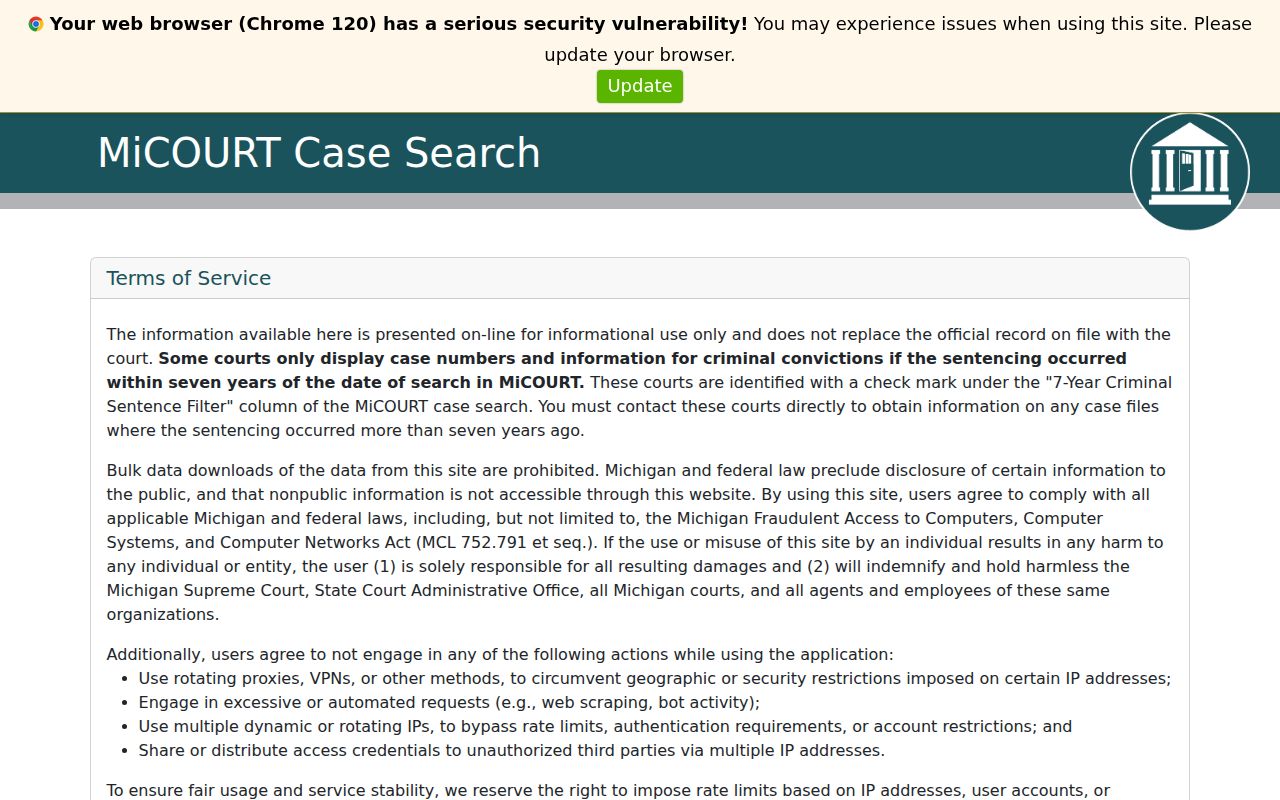
Treat the public screen as an index and case-history tool. When an official copy matters, check any displayed result against the court of record. Use the public Court Display or a judge schedule. That gives the date, time, and room. The case history is the better spot for a later notice, order, adjournment, or disposition. MiCOURT information is informational. The court of record remains the source for a certified result. It also handles a last-minute calendar confirmation.
Searching by Case Number
A complete Kalamazoo County case number beats a name. Use it when it is printed on a notice, citation, or court order. MiCOURT documents its case docket ID as YYYY-Number-Type, sometimes with a role-number suffix after it. A local Circuit register example is 2020-6382-DC. The year marks when the case opened, and the middle sequence marks the case itself. The type code marks a court-managed category. That code set is not a universal key for every District ticket or Circuit case.
Enter the full identifier exactly as it appears. One District case can carry several defendants and role numbers. A case-number result may list more participants than a name query would. A felony can also leave District Court after a preliminary examination. It can then continue under a Circuit number. When a register shows bindover, transfer, or appeal activity, check the receiving court.
Kalamazoo Case Number Role Fields
Role numbers and related-case fields explain a common sight. One Kalamazoo search can return several entries tied to a single case. A register may show an original case number. It may also carry a role number, a transfer, a claim of appeal, or a reassignment event. None of these entries creates new public documents on its own. They point you to where to look next in the court record.
- Case history
- MiCOURT’s chronological list of recorded case events.
- Role number
- An added identifier that can distinguish participants or related entries in a case docket ID.
- Bindover
- The transfer of a felony matter from District Court to Circuit Court for final adjudication.
- Claim of appeal
- A notice that a party seeks review in a higher court; later transcript or transfer entries may follow.
If a number is incomplete, recover the missing part from the citation or notice, then ask the court that created the record to confirm its format. The county publishes no single complete local code glossary. Note that a transfer, role number, or appeal entry only identifies a connection between records; it does not itself establish the final case outcome.
What a Case Search Returns
A Kalamazoo County case search may return the basics. Those include a case number, case style, court, filing date, case type, judicial officer, status, and case history. Detail pages can add more. Party roles, charge or claim information, financial fields where supplied, hearing data, and a disposition may appear. What you see depends on the court and the public status of the case. Protected identifiers are redacted, and an online history never substitutes for the filed document.
Read the event register in date order. Each entry describes a recorded step. A complaint filed, summons filed, motion, order, notice, hearing, adjournment, transcript, appeal, reassignment, disposition, or closed entry all count. The document itself is not always attached.
| Case number | The court-assigned identifier, sometimes with a role number. |
|---|---|
| Case style and roles | The caption and public party labels, such as plaintiff, defendant, petitioner, or respondent. |
| Court and type | The division and category needed to identify the proper records custodian. |
| Case history | Dated events, descriptions, and sometimes party, count, comments, or document references. |
| Setting and status | Next hearing data where displayed, plus active, disposed, inactive, closed, or other entered status. |
MiFILE Is Not Kalamazoo Case Search
People often mix up two very different Michigan tools. MiFILE (TrueFiling) handles filing and service, not public browsing. It sits behind an account and a login. Kalamazoo 8th District made e-filing mandatory for eligible attorneys in 2025, and self-represented parties may join in but face no such mandate. None of that makes MiFILE a way to skim case histories or pull public court documents from Kalamazoo County. For a free docket search, it is the wrong door.
The MiFILE login screen shows the sign-in page for the account-based filing system itself, which is what visitors hit when they arrive there.
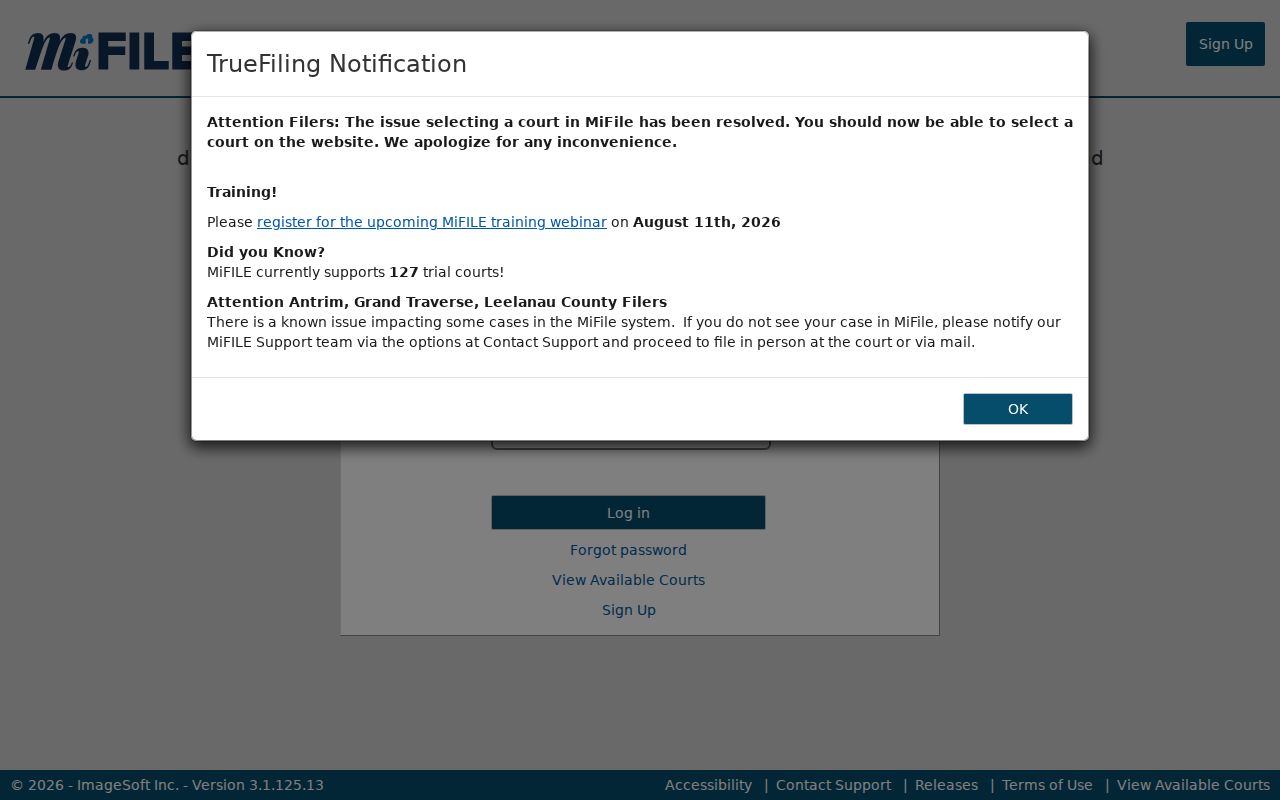
So where should a Kalamazoo case search actually begin? Start with MiCOURT for public case history. When you need a filed document, a certified copy, or a Circuit record that never went online, the clerk and the public terminal at the courthouse are the path instead.
Statewide vs County Case Search
Think of the choice as two layers. MiCOURT is Michigan’s statewide public search for participating courts. Kalamazoo County adds court-specific routes plus direct clerk access. The D08 route works well for a known District matter. Unsure which court holds the case, or dealing with another participating Michigan court? The statewide entry earns its keep. Neither route produces certified copies, and both leave out restricted categories.
| Search route | Best use | Important limit |
|---|---|---|
| MiCOURT statewide search | Public cases across participating Michigan courts. | Availability and public fields vary by court and case type. |
| Kalamazoo D08 search | District traffic, misdemeanor, civil-infraction, and qualifying civil matters. | It does not replace a Circuit, Probate, or restricted-record route. |
| Kalamazoo Probate Index | Probate case detail, fiduciary, and index searches. | It covers 1995-current entries and has no online images. |
| Clerk or public terminal | Circuit records, file copies, and records not available online. | Requests must identify a specific case or parties. |
Probate works differently. Use the county’s Probate Court Index for those files instead of assuming one search covers everything. For a traffic citation, Michigan ePAY is the ticket lookup; MiCOURT D08 remains the public case-history fallback.
Kalamazoo Circuit Case Terminal Path
Kalamazoo County posts no online Circuit docket page covering all Circuit records. Instead, the county points visitors to public terminals and hard-copy public portions. Both sit at the Judge Charles A. Pratt Justice Center and the Gull Road Justice Complex. Calling the Circuit Clerk first is smart. A file may sit in archives awaiting retrieval. As the county court-record access notice explains, this runs as a court access process. It is not an ordinary FOIA request.
Federal matters sit outside any Kalamazoo County case search entirely. PACER’s fee information governs federal docket and document access, not MiCOURT.
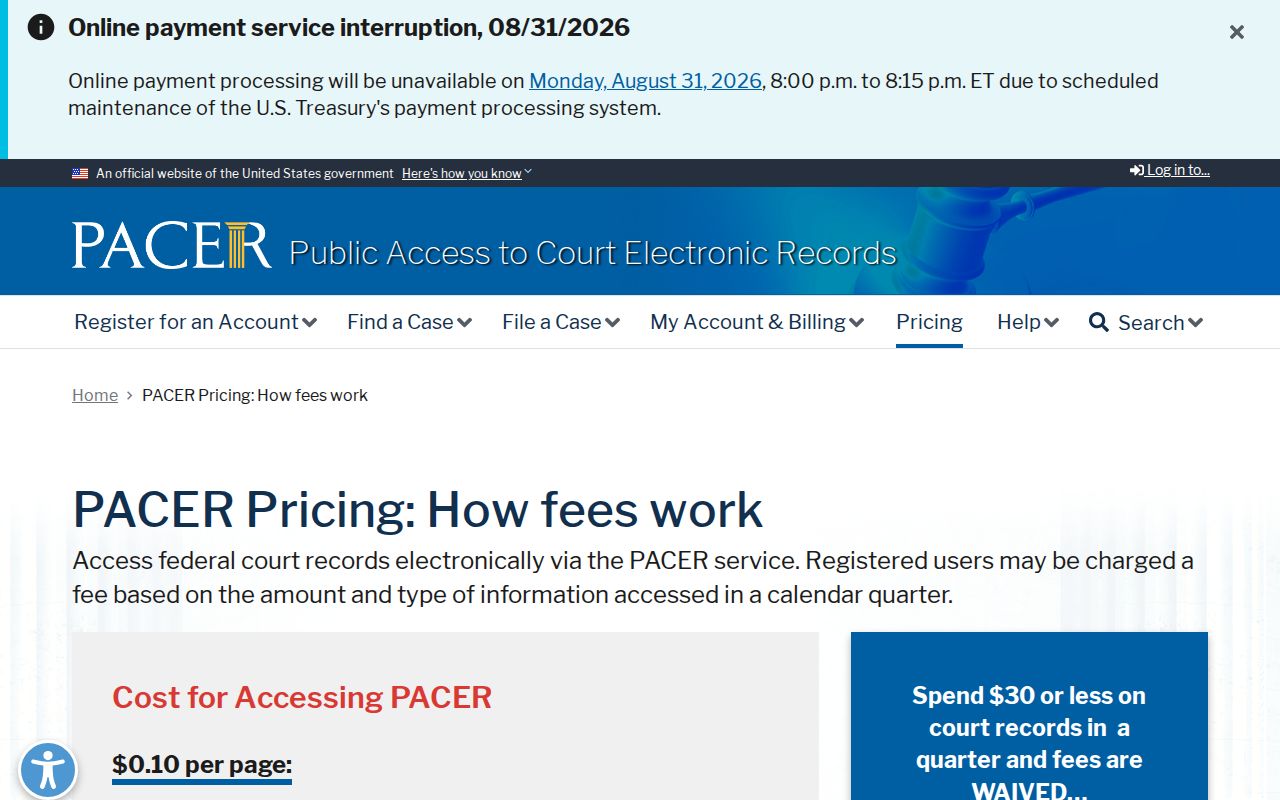
One free federal option exists: CourtListener and RECAP. Coverage there can be spotty, though, and it never replaces the authoritative federal docket.
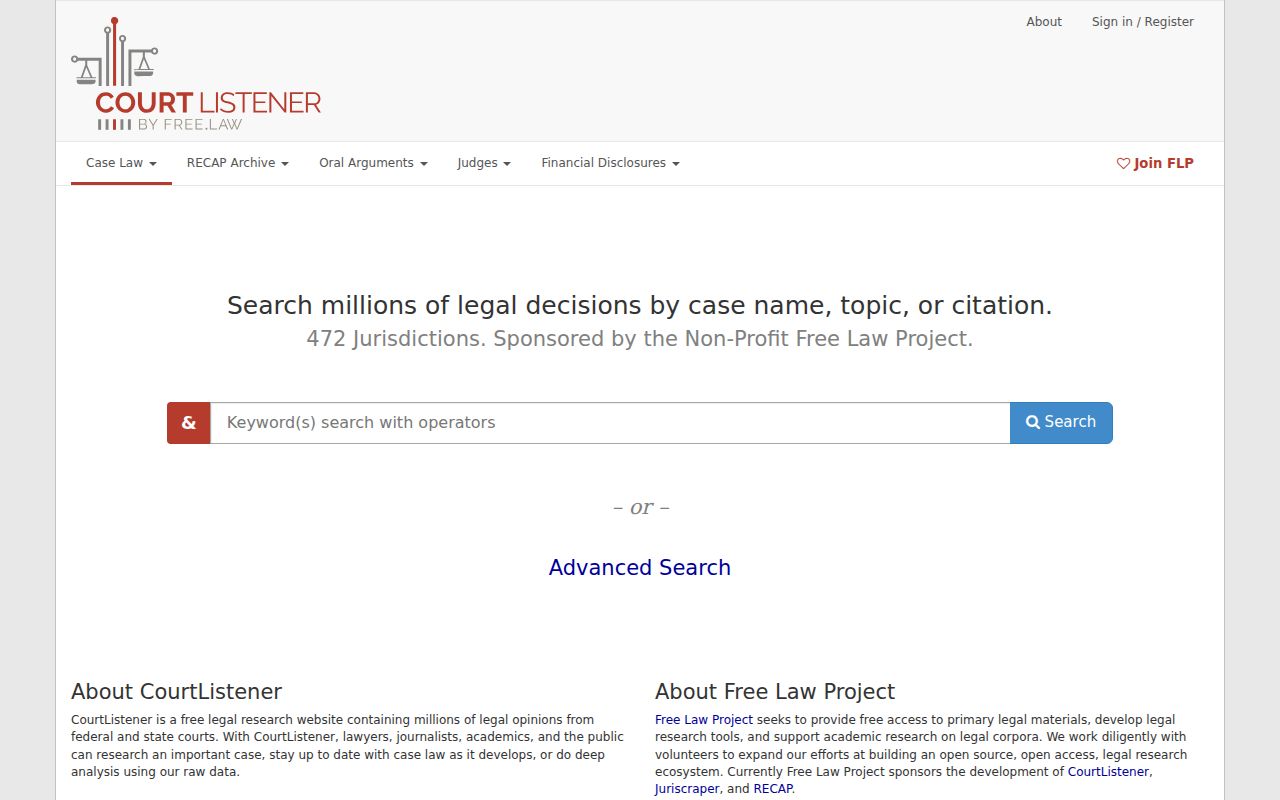
Those two federal tools carry a lesson for any case lookup. Identify the court and the office holding the record before you start searching.
Kalamazoo Probate Case Search Path
Probate follows its own local route, so skip the generic Kalamazoo name search. The Probate Court Index provides Case Detail, Fiduciary, and Index functions. Per the county, it covers 1995 to the present with real-time entry. It includes older still-active cases. Sequestered ones are excluded. Document images are not offered online.
An older Kalamazoo Probate file means a visit or a call to the Civil/Probate Division at the Gull Road Justice Complex. Records from 1832 through 1990 live mostly on microfilm. Files from 1990 through 1995 remain in paper form. That history is why an index result can exist while nothing downloadable does.
Access and Restricted Cases
Under Michigan Court Rule MCR 8.119, public court records are open to inspection and copying. Only a statute, court rule, or qualifying order changes that. Michigan’s public MiCOURT notice bars many categories from the internet. The list includes juvenile and child-protective matters, adoptions, mental-health cases, and name changes. PPOs and wills are on it too. A sealed or nonpublic case may return no party result or a restricted entry. It may show nothing but a case number. And a blank result never proves the filing does not exist.
Older criminal convictions face another wrinkle: MiCOURT applies a seven-year filter at participating courts. District document images are generally absent from public internet access too. For a specific public document or a certified copy, go through the clerk. Follow that court’s own procedure for restricted records. Full request steps and copy rules sit under Kalamazoo County court records.
Note: A case history can tell you where to ask. But only the court of record can confirm any date, filing, or official copy that affects a real case.