
How to Get Court Records
A solid Kalamazoo County docket request has three parts. You need the court, a complete case number, and the exact item. MiCOURT Case Search is the free way to pull a public case number and its history. Probate matters run through the county Probate Index. For Kalamazoo 8th District Court records, the District clerk handles copies through its record-copy form. Circuit, Family, Civil/Probate, and Probate files each go to their own court facility and clerk contact. Remember what an online docket entry shows: that an event happened. It does not hand you the filed document, the recording, or a certification. Only a clerk request gets those.
Every access channel the court offers stays in play. You can search an online index, or use a public terminal at the Pratt or Gull Road locations, call the right clerk, or file a written or online request. One gap to note: Circuit records have no general public Circuit docket page. If a file may sit in storage, call ahead. Above all, never ask for every record on a person. A request works when it names one case and one item.
- Find the court and complete case number through MiCOURT, the Probate Index, a citation, or a public terminal.
- Name the exact record, such as a case history, complaint, signed order, judgment, transcript, recording, or certified copy.
- Send the request to the District, Circuit, Civil/Probate, or Probate custodian that holds that file.
- Use the clerk’s timing and fee route, then confirm whether a public restriction or archive retrieval changes access.
Kalamazoo District Copy Request Form
The 8th District Court Record/Copy Request form is built around a single case. It asks for your contact details and the case number. It also wants the offense and offense date when that applies, party names, and the versus caption. You also pick what record you want. Choose review or copy, and you can opt for an email copy. Staff can work from a complete case number or party names. If you have neither, check a public index or terminal first.
The District form lays out the case-specific fields that make a Kalamazoo court-record request workable.
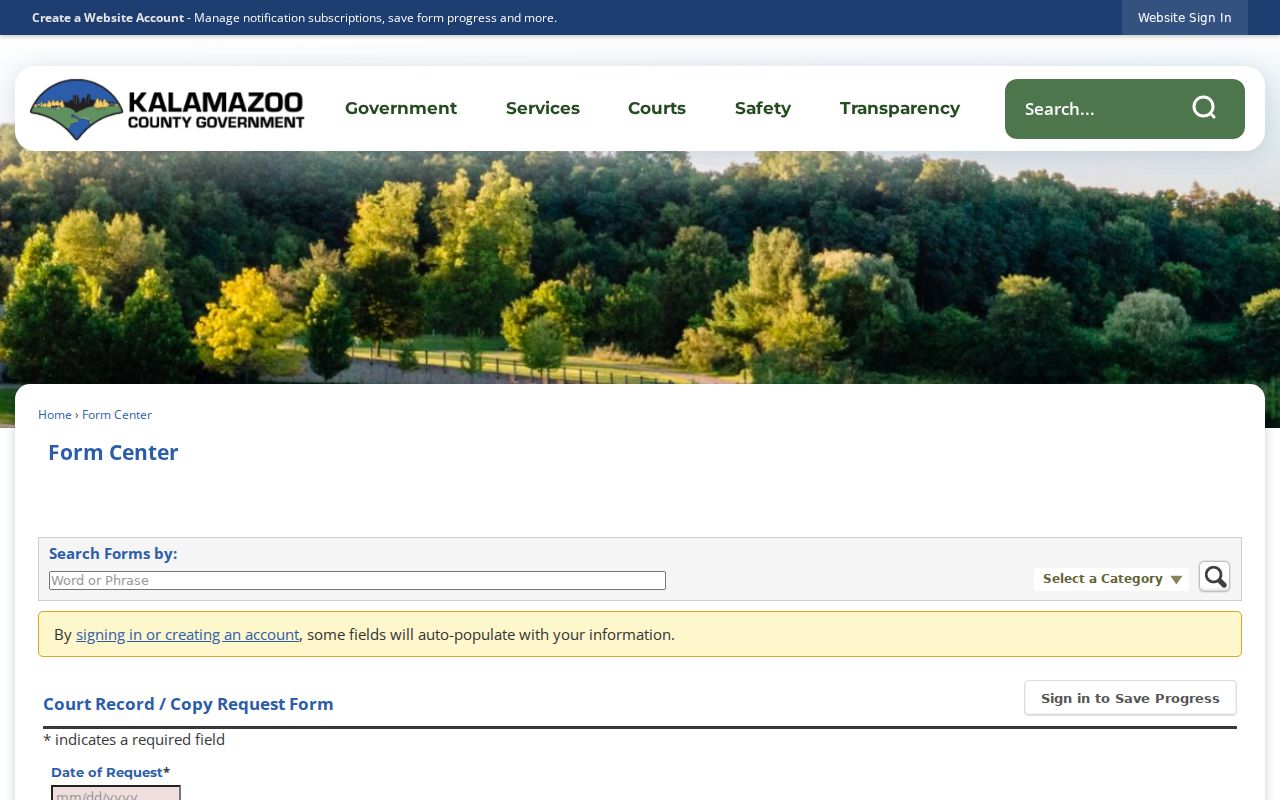
Timing on the live form is five to seven days. The local access order sets quicker standards for some identified active files, though. A bulk record check on an unknown case does not fit the court's process. The court expects a specific case. It can use a name or public index to find the case. Even so, a specific request is required before any file gets copied.
Types of Court Records
Kalamazoo court records are not one product. A docket, or register of actions, is the dated history of what the court recorded. A case file is the material underneath it: the complaint, petition, motion, order, judgment, exhibit, transcript, or recording the clerk holds. A certified copy is different still. The clerk authenticates it through the court's certification process. Printing a public MiCOURT result gives you none of that. It is just a printout.
Wording matters when you ask. If you need a signed order, say so instead of asking for "the case record." A recording is not a transcript either. One public docket entry may point to a document that needs its own inspection or copy request. The court can also seal a particular filed item. Basic case information stays public even then.
Kalamazoo Record Products Compared
Know the difference before you request anything in Kalamazoo. There is a docket, a case file, and a certified copy. MiCOURT and the Probate Index locate public case information. Clerk-held files hold the actual materials available under court rules. Certification is its own step, because the clerk must authenticate the copy. So match the product to the task: locating a case, reading a public filing, or getting the official form another court or agency requires.
| Product | What it provides | Normal Kalamazoo route |
|---|---|---|
| Docket or case history | Recorded events, settings, status, and disposition information. | MiCOURT, Probate Index, or public terminal. |
| Filed document or case file | The specific pleading, order, exhibit, recording, or other court-held item. | Correct clerk or records request procedure. |
| Certified copy | A clerk-authenticated copy of the requested record. | Ask the custodian for certification and its current fee. |
Probate's county-hosted index shows no images online. For older Probate matters, microfilm and paper can be the practical source.
What a Court Record Contains
A public Kalamazoo case record can hold a header, party roles, case facts, a dated register, setting information, and financial or disposition entries. What appears depends on the court and the case type. Criminal records may add counts and charge details. Civil and Probate records use their own case and party fields. Protected personal identifiers and nonpublic material stay out of ordinary public view.
The clerk keeps more than the history you see on a screen. The local 8th District access order lists case files, registers of action, numerical and alphabetical indexes, calendars, and court recordings or media. Name the category in your request. That simple step helps it land with the right unit.
| Header | Case number, court or division, case type, filing date, judicial officer, and status. |
|---|---|
| Parties and counsel | Public role labels and attorney information where entered, subject to redaction. |
| Register | Dated filings, notices, hearings, orders, transfers, and other recorded events. |
| Setting | Date, time, room, court, officer, and setting type where shown. |
| Outcome | Disposition, judgment, closed date, appeal, balance, or other case-specific entries where public. |
Kalamazoo Transcript and Recording Requests
A transcript is not a case-file copy. It gets its own process. The 8th District transcript request form asks for the court event, the event date, the judge or magistrate, the case number, plaintiff and defendant fields, the event type, the date needed, appeal status, and your contact information. The form states a deposit is required. Rates run $4.65 per page with a $50 original minimum, and the reporter contacts the requester in seven to ten business days. For preliminary-examination transcripts, route the request to the 9th Circuit Clerk.
The transcript form shows the event-specific details a Kalamazoo court record request needs.
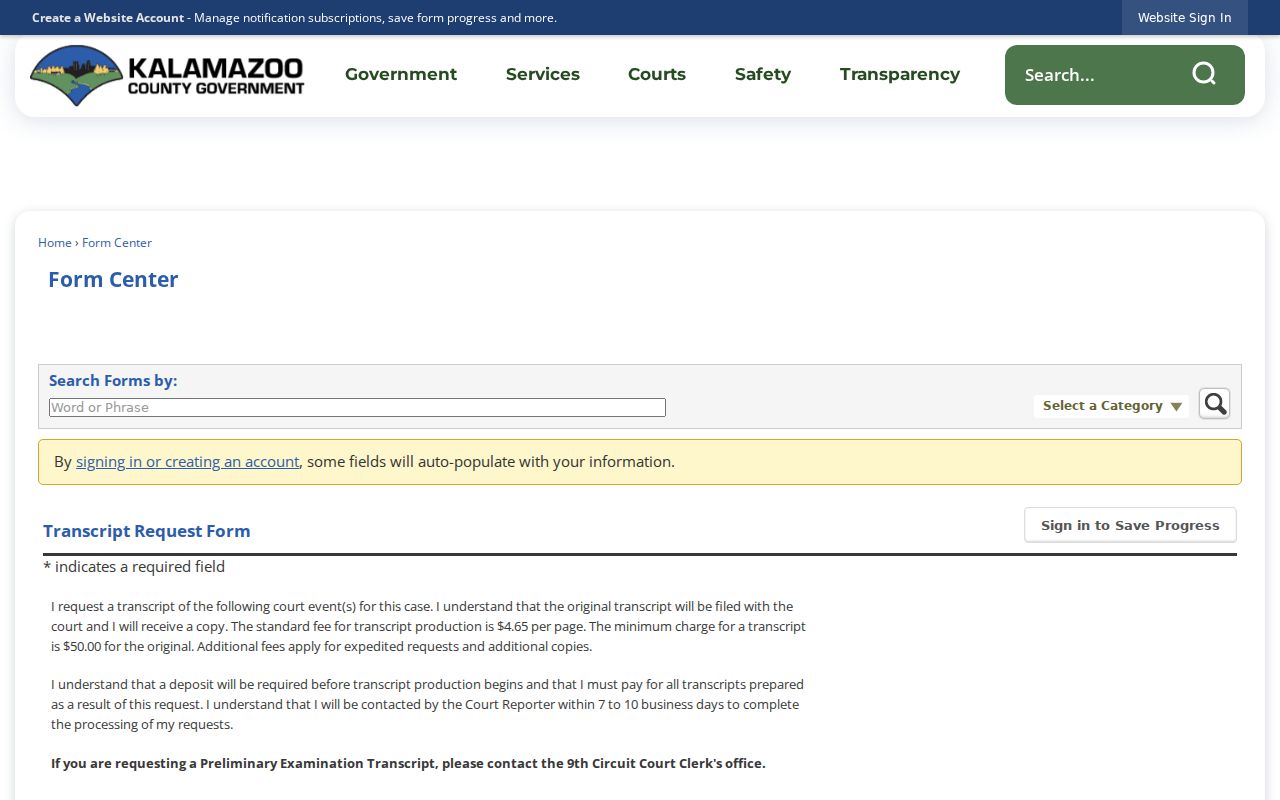
In the District, a DVD of a hearing runs $20 per copy under local policy. It is not an official transcript, so plan accordingly. Circuit video works differently. That court has its own request form, its own approval step, and its own mailing conditions before anything goes out. Ask for the exact item you need. Audio, video, and transcripts are three different products in a Kalamazoo County courtroom file, and treating them as interchangeable only slows the request down.
Certified Copies and Fees
Looking at District case records costs nothing. Local Administrative Order 2025-04 makes inspection of those public court records free. Copies work on a sliding rule. For District documents of 25 or fewer pages, the charge is $1 per page after the first five pages. The live form spells out how that first-five-pages-per-person-or-law-firm-per-day allowance is counted. Bigger requests get filled within a reasonable time. If you qualify as indigent, copy costs past five pages may be waived. No flat certified-copy fee exists for Circuit or Probate. So call the division directly rather than guessing at a price.
| District item | Amount or timing | Important condition |
|---|---|---|
| Public inspection | $0 | Specific public case records only. |
| Case documents, 25 pages or fewer | $1 per page after first 5 | Local form and access order govern the request. |
| Active-file access | Normally within 2 hours | Up to five specific active files. |
| Stored file retrieval | Up to 10 business days | Archive status can change timing. |
| District DVD | $20 per hearing | A recording is not a transcript. |
Direct your request to the court that actually holds the file. The County Clerk/Register of Deeds office is not the default counter for 8th District case files. Going there first just adds a trip.
8th District Court records
Judge Charles A. Pratt Justice Center
330 Eleanor Street
Kalamazoo, MI 49007
269-384-8171
District criminal, civil, traffic, inspection, and copy-request contact.
9th Circuit criminal records
Judge Charles A. Pratt Justice Center
330 Eleanor Street
Kalamazoo, MI 49007
269-383-8837
Call for Criminal and Trial Division file access or archive questions.
Civil/Probate and Probate records
Gull Road Justice Complex
1536 Gull Road
Kalamazoo, MI 49048
269-383-8666
Call for Probate file, microfilm, copy, and certification procedures.
Kalamazoo Probate and Circuit Archive Path
Older Kalamazoo County records live in a few different places. The Kalamazoo Probate Index covers 1995 to the present in real time, with some older active cases mixed in, though it shows index entries only. No document images there. Probate files from 1832 through 1990 sit mainly on microfilm, and the stretch from 1990 through 1995 is still kept in paper form. Circuit records call for a visit, either hard-copy review or terminal access at Pratt or Gull Road, and the clerk asks that you phone ahead so archive material can be pulled. A docket search that returns no image is not the end of the road. Use these local paths before concluding no record exists.
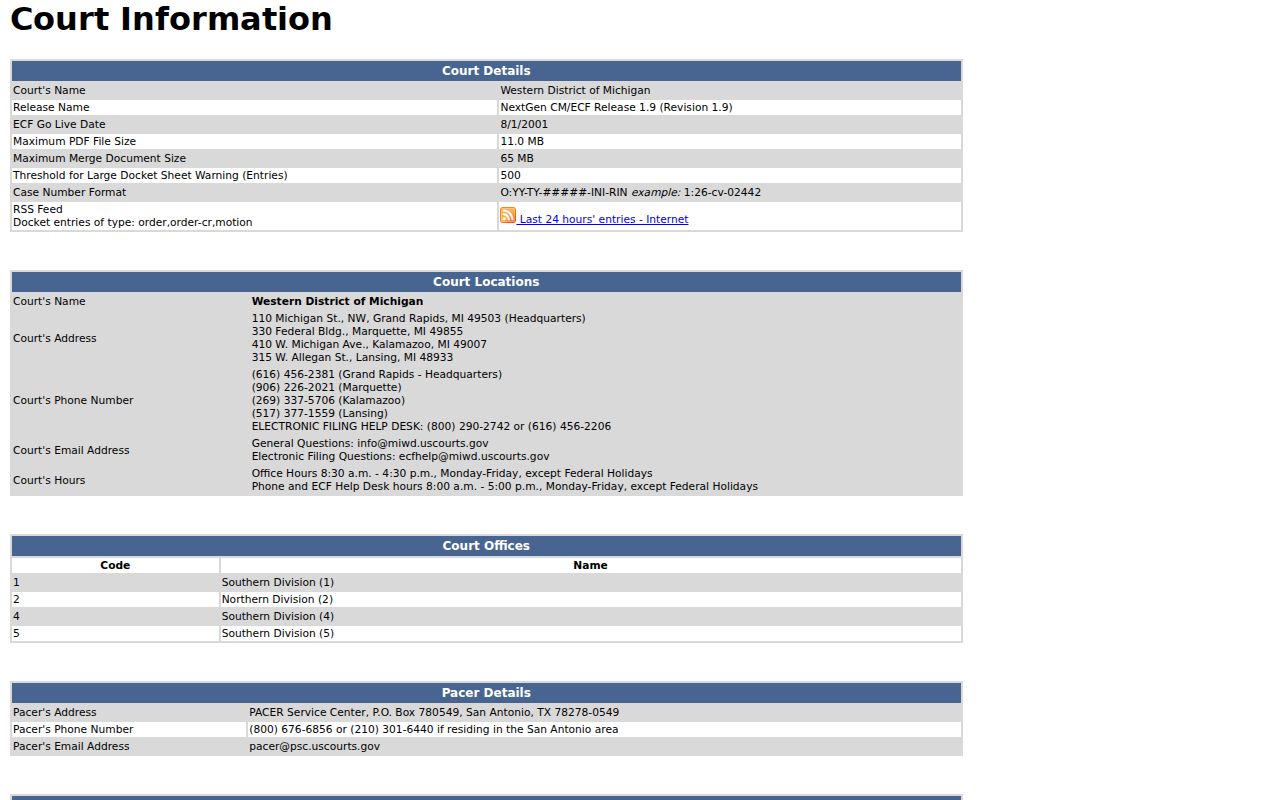
Federal court records run on a separate system. The Western District CM/ECF information page describes that court's docket engine in detail. Public reading of federal cases generally goes through PACER instead of the Kalamazoo County clerk.
Bankruptcy is separate too. The bankruptcy court location notice confirms that federal bankruptcy records follow their own office and their own access route, apart from anything the county clerk handles.
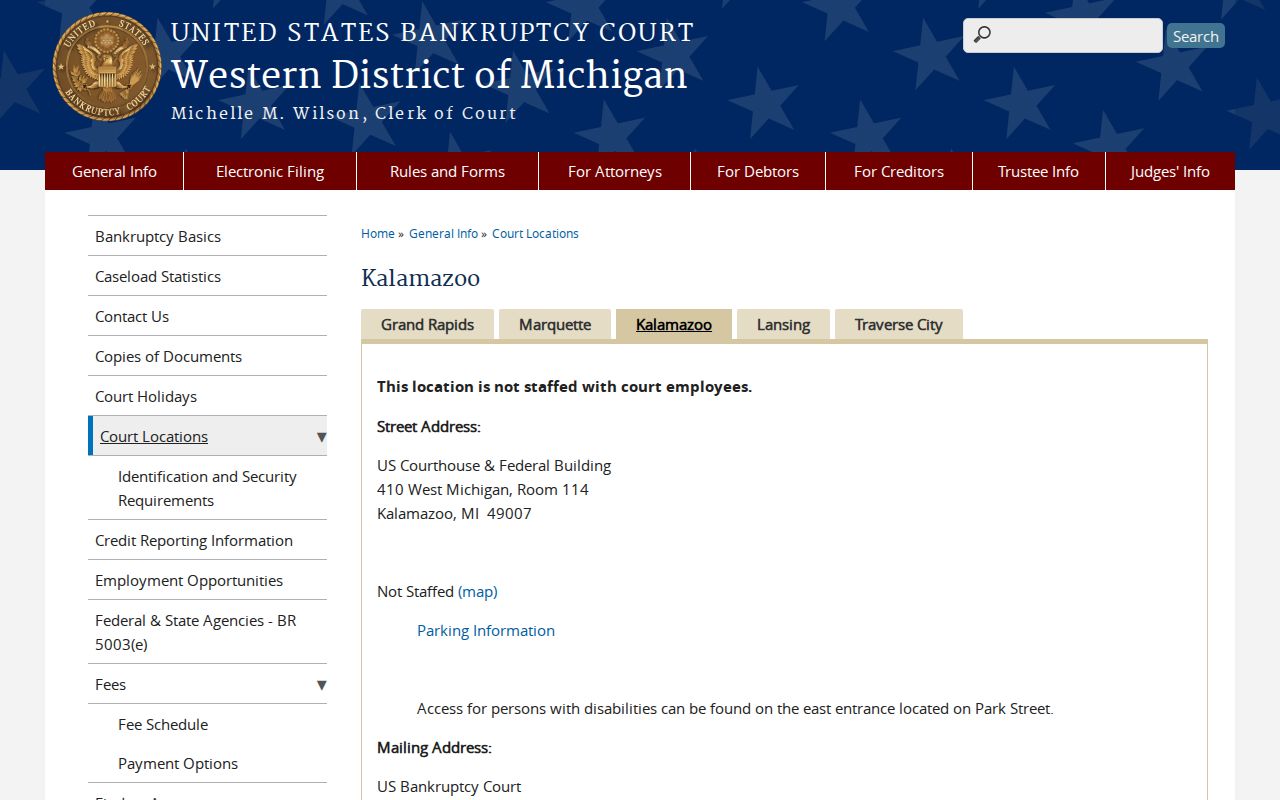
Keep the state and federal routes straight and you will end up at the right records office with the right request. Note: Archive retrieval and a public index search are different services, so an older file can take longer than a current case-history lookup.
Public Access and Sealed Records
Access to Kalamazoo County court records runs on court rules. The county's usual public-records process does not apply here. Michigan Court Rule MCR 8.119 governs public inspection and copying unless a statute, rule, or court order says otherwise. FOIA is the wrong door here. Michigan's FOIA definition leaves out the judiciary. That includes the County Clerk when the office is acting as Circuit Court clerk. Kalamazoo's own court-records access notice points requesters to court procedures instead.
Restricted record warning: Juvenile, adoption, child-protective, mental-health, PPO, will, set-aside, and sealed records can be absent, redacted, or limited. A clerk can explain the access route but cannot release material that a statute, rule, or court order makes nonpublic.
The 2025 local order gives the public real access to identified District files. Inspection is permitted. So is photography with a portable device. It must leave no mark and not interfere. One limit stands: no file leaves the building without a court order. When a record mixes public and protected material, ask for the specific public portion rather than the whole thing. Note: A public case number does not override a rule or court order. Such a rule may limit access to a particular document or case type.
Kalamazoo Court Records Are Not FOIA
Send a court record request to the office that holds the file, not to county FOIA. This matters most for Circuit records. There is no public online Circuit docket, and review may require a terminal or hard copies. The District record-check memorandum adds one more requirement. A court record request needs a specific case number or party names, though an index can help you locate the case first. That rule keeps every clerk request tied to a known court file. Start a public case history with the Kalamazoo County case search. For the order, file, transcript, or certified copy behind that history, follow the court-record route described above. Note: Certification and restricted access always depend on the office holding the record and the governing court rule.